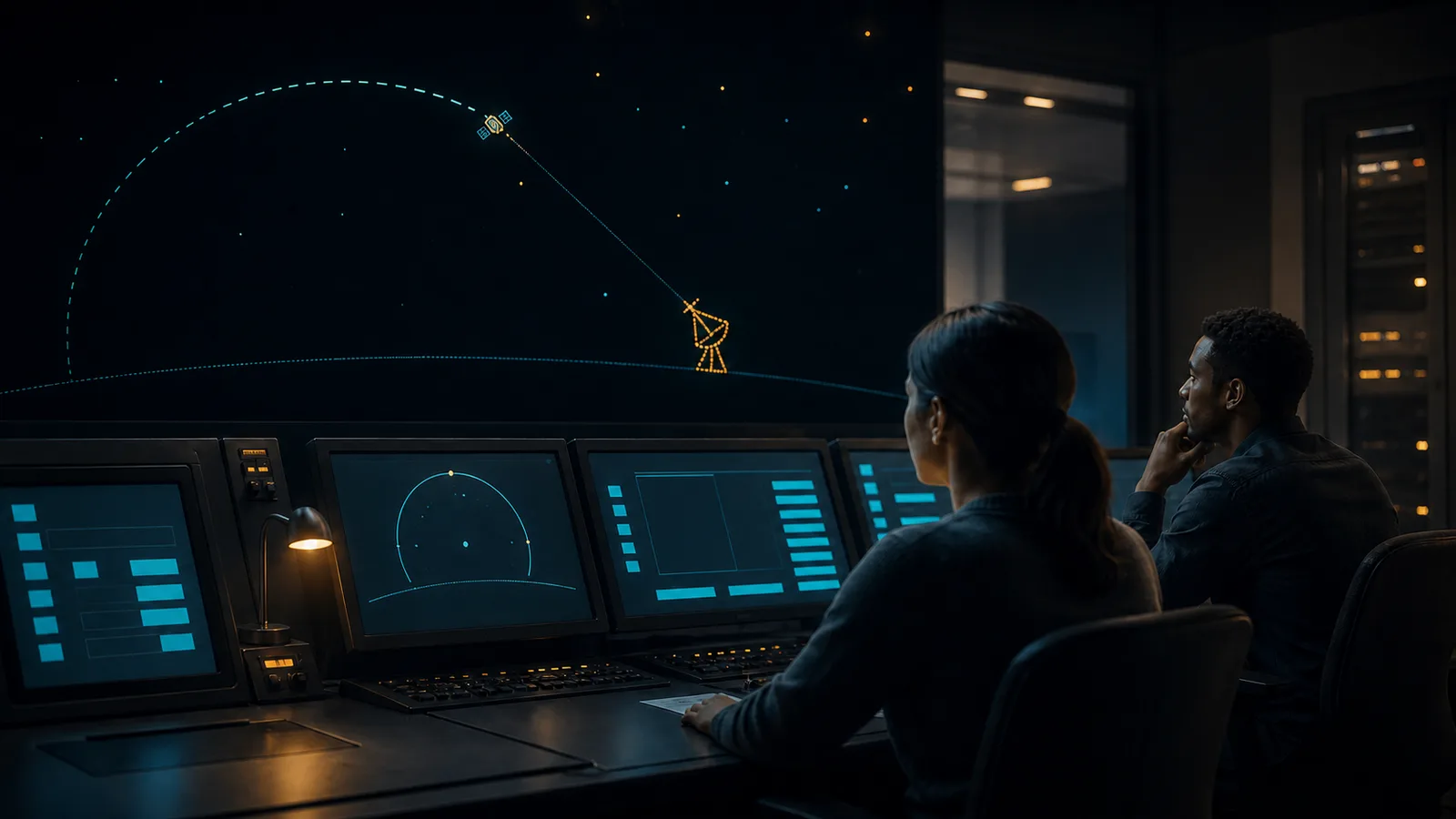

A spacecraft can be healthy and still fail its mission if the ground team sends the wrong command, misses an anomaly, or loses track of a constraint. Space operations programs focus on the planning, procedures, communications, systems, and decisions that keep missions running.
This is a small and unusually named degree field. You should inspect every space operations degree at the course level because a broad space studies label may lean toward policy, science, engineering, or operations.
What Is a Space Operations Degree?
A space operations degree studies how people and systems plan, command, monitor, and support space missions. The subject can include orbital mechanics, satellite subsystems, ground stations, communications, mission planning, procedures, space policy, risk, cybersecurity, and team coordination. The balance depends on the school.
The federal CIP definition places these programs in Space Systems Operations rather than aerospace engineering or astronomy. That boundary is useful: operations students may work with vehicles and scientific missions, but their central question is how to run the system safely and effectively.
| Degree field | Central question | Typical evidence |
|---|---|---|
| Space operations | How do we plan, monitor, command, and recover the mission? | Procedures, simulations, mission plans, system knowledge, and team decisions |
| Aerospace engineering | How do we design and verify the vehicle or subsystem? | Analysis, models, designs, tests, code, and engineering reports |
| Astronomy or astrophysics | What does the mission’s data tell us about a physical system? | Research, observations, simulations, code, and scientific findings |
| Space policy | Which rules, institutions, and choices govern space activity? | Policy analysis, research, writing, and regulatory or strategic work |
What Do You Study in a Space Operations Program?
Strong operations curricula connect orbital and spacecraft fundamentals with the process of running a mission. Look for courses or exercises that make you interpret telemetry, work through procedures, coordinate a pass, respond to a simulated anomaly, or explain a decision to another technical team.
Course names can sound operational without requiring applied work. Read the syllabus descriptions and capstone format. A simulation, mission exercise, laboratory, or applied project gives you better evidence than a list of broad survey courses.
Mission Planning
You learn to turn objectives and constraints into timelines, activities, and decision points.
Spacecraft and Ground Systems
You need enough subsystem knowledge to understand telemetry, limits, interfaces, and failure states.
Orbital and Communication Fundamentals
Operations depend on where the asset is, when it can communicate, and which resources a task consumes.
Procedures and Anomaly Response
The work rewards precise steps, clear escalation, and calm reasoning when the system departs from plan.
Technical Communication
Logs, handoffs, briefs, and decisions must make the mission state clear to people with different specialties.
How Many Space Operations Degree Programs Are There?
The federal snapshot used for this site contains 6 records in Space Systems Operations. 2 are bachelor’s records and 4 are master’s records. That is far smaller than the 127 aerospace engineering records and 128 astronomy, astrophysics, and planetary-science records in the same directory.
The small count makes a national comparison more useful than a generic state search. Start with the national program rankings, then inspect the official program page for delivery, course rotation, simulations, capstone work, and the students the program is designed to serve.
Which Careers Connect to Space Operations?
Relevant job searches can include mission operations, satellite operations, spacecraft operations, ground systems, flight operations, mission planning, orbital analysis, command and control, payload operations, and technical program support. Titles differ by employer, so search by task as well as title.
Space operations is not one BLS occupation with one salary. Match the program to the specific work you want, then use the career guides and occupation salary pages for that role. Engineering, technician, software, and management positions can sit near an operations team while carrying different education requirements and wage data.
Experience matters because operations is procedural and system-specific. Simulations, internships, military experience, ground-station work, student satellite teams, and technical projects can make the curriculum visible to an employer.
Can You Earn a Space Operations Degree Online?
One of the 6 federal records carries a distance-education flag. That flag can be recorded above the individual program level, so verify the delivery format directly with the school. Ask how simulations, group exercises, laboratories, examinations, and any residency work are handled.
Online study can fit working professionals when the program makes scheduled operations work clear. Check time zones, live session expectations, access to software or simulation environments, and whether the capstone requires an employer project or campus equipment. The online space studies rankings separate the federal signal from the school-level confirmation.
How Should You Choose a Space Operations Program?
Start with your entry point. A first bachelor’s degree should build technical foundations and applied experience. A master’s for a working professional should deepen a role, move you toward mission leadership, or close specific technical gaps. A master’s used only because the title sounds specialized may add cost without changing your work.
Inspect the applied work.
Find the simulations, laboratories, capstone, procedures, and system tools you will use.
Match the audience.
Check whether the curriculum assumes military, engineering, science, or operations experience before entry.
Read the faculty profiles.
Look for recent operational work and teaching tied to the mission areas you care about.
Ask about employer access.
Internships, student satellite projects, government partnerships, and local employers can change the value of a small program.
Confirm every requirement.
Use the official catalog for delivery, prerequisites, course rotation, and the final project.
How Are Space Operations Programs Compared?
Our rankings keep Space Systems Operations records inside their exact federal field and degree level. A master’s in operations is compared with other master’s records in that field, not with an aerospace engineering bachelor’s or an astronomy doctorate.
Read the published ranking methodology for the CIP boundary, federal data fields, and scoring rules. The method creates a consistent starting point while the official program page supplies the curriculum you need for the final decision.
Questions readers ask
Frequently Asked Questions
What Degree Do You Need for Space Operations?
Is Space Operations the Same as Aerospace Engineering?
Does Space Operations Require Math?
Can You Study Space Operations Online?
What Skills Matter in Mission Operations?
Research note
How This Guide Was Checked
Program counts come from the federal IPEDS program records used in this directory. Occupation figures come from the Bureau of Labor Statistics Occupational Employment and Wage Statistics release dated May 2025. Read the ranking and data methodology for the exact program boundaries and scoring rules.