The occupation
What Does an Atmospheric and Space Scientist Do?
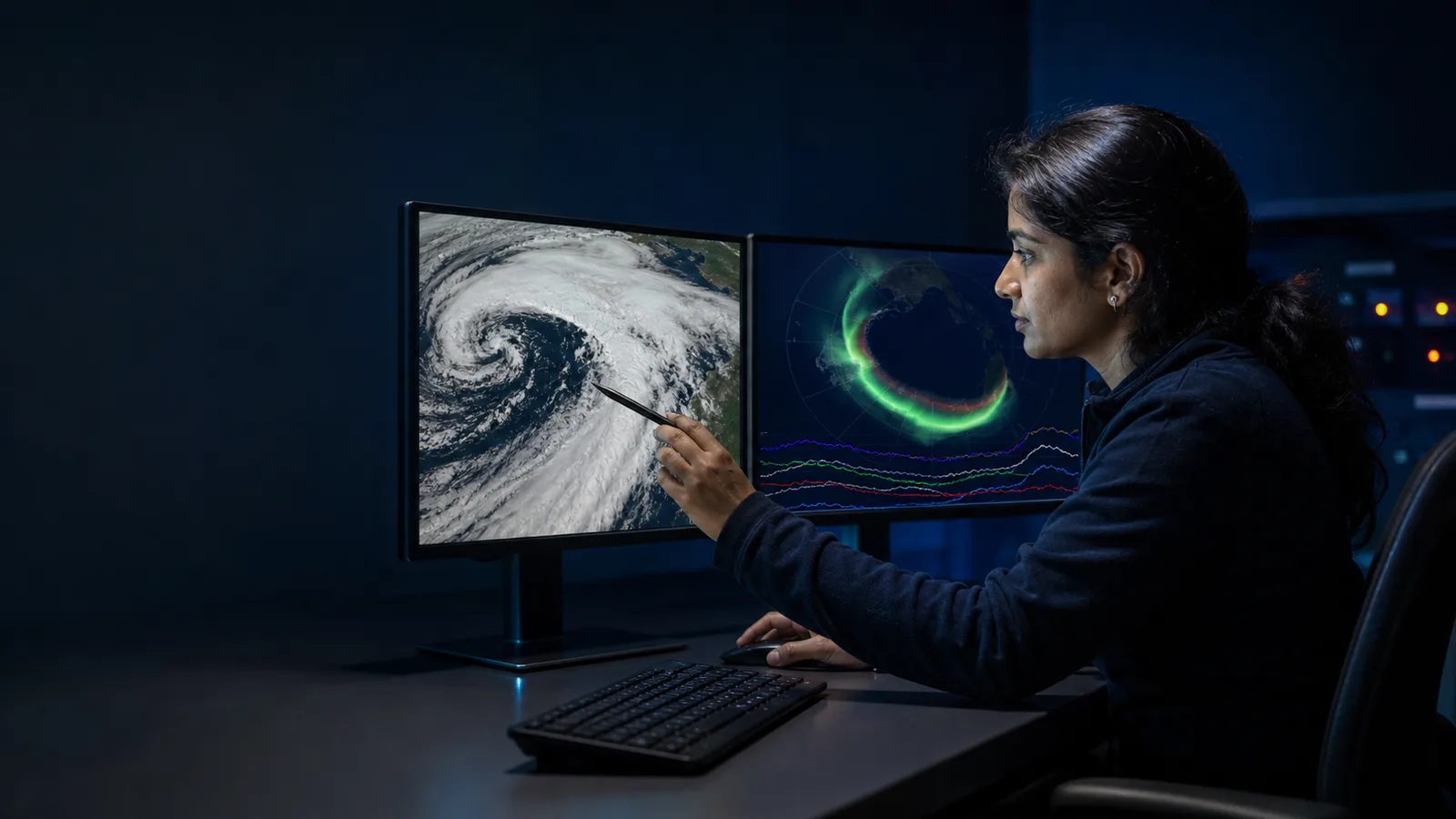
These scientists measure atmospheric properties, analyze observations with computer models, write software, improve instruments, prepare forecasts and reports, and communicate conditions that affect people and operations.
Use these duties as the first reality check when planning how to become an atmospheric and space scientist.
- Measure temperature, humidity, wind, and other atmospheric properties
- Analyze atmospheric data with computer models
- Write software that supports modeling and data work
- Prepare forecasts, graphics, reports, and warnings
- Conduct research and help develop data-collection instruments
The working day
A Day in the Life of an Atmospheric and Space Scientist
A forecasting day begins with observations and model output. You compare radar, satellite, station, and other measurements, decide which model behavior is credible, and turn the result into a forecast or warning someone can act on.
A research day may focus on code, an instrument, or a dataset instead. Field roles can add travel and direct observation, while operations centers need coverage when weather does not follow office hours.
Education route
How to Become an Atmospheric and Space Scientist, Step by Step
When you plan how to become an atmospheric and space scientist, use the sequence below to see where a space-focused degree fits and where you need additional preparation. Meteorology or atmospheric science is the usual bachelor’s route; a space science degree needs the required atmospheric physics, mathematics, modeling, and programming.
- 01
Choose the Atmospheric Route Deliberately
A bachelor’s degree in meteorology, atmospheric science, or a related physical science is typical. Coursework may include physics, mathematics, and computer programming.
- 02
Check Course Requirements, Not Just the Major Name
A general astronomy or space studies degree may miss atmospheric thermodynamics, fluid behavior, forecasting, and observational methods.
- 03
Learn Models and Communication Together
You need to interpret large datasets and explain the result clearly enough for the public, a client, or another technical team to use it.
- 04
Use Internships or Service Experience
BLS notes that internships, volunteering, and military experience can help candidates prepare for operational work.
- 05
Plan Graduate Study for Research
Research positions typically require at least a master’s degree or a Ph.D. in atmospheric science or a related field.
Where the work happens
Where Atmospheric and Space Scientists Work
Weather Stations and Operations Centers
Operational scientists monitor changing conditions and may work shifts to provide continuous coverage.
Offices and Laboratories
Research and technical-service roles center on models, code, instruments, datasets, and reports.
Field and Broadcast Settings
Some scientists travel to collect data or observe events. Broadcast meteorologists work in studios and may report from outdoor locations.
Technical directions
Atmospheric and Space Scientist Specialties and Focus Areas
Operational Forecasting
Forecasters combine observations and models to describe current conditions and predict what comes next.
Atmospheric Research
Researchers study weather and climate processes and may develop new models or instruments.
Applied Meteorology
Private and public organizations use weather analysis for transportation, energy, agriculture, water, and other decisions.
Broadcast Meteorology
Broadcast roles add public communication and graphics to the scientific interpretation.
Before you commit
The Hard Parts of Becoming an Atmospheric and Space Scientist
The Degree Requirements Are Specific
A space-themed major can still miss the meteorology and atmospheric science courses employers expect.
Operational Work Runs Around the Clock
Forecasting positions may require shifts, nights, weekends, or extended hours during severe weather.
You Communicate Under Pressure
Warnings and forecasts must turn uncertain model evidence into language that people can use.
Research Adds Graduate Study
A bachelor’s degree is typical for entry, while research positions commonly require a master’s degree or Ph.D.
BLS wage data
How Much Do Atmospheric and Space Scientists Make?
The national median is $99,070. The full OEWS wage span runs from $53,060 at the 10th percentile to $161,890 at the 90th. A percentile is a place in the wage distribution, not a promise about your experience level.
Where to study
Schools That Lead Here
Common questions
How to Become an Atmospheric and Space Scientist: Common Questions
What Degree Do You Need to Become an Atmospheric and Space Scientist?
Does Any Space Studies Degree Qualify for This Occupation?
Do Atmospheric Scientists Work Nights?
What Do Atmospheric Scientists Do with Satellites?
Do Atmospheric Science Research Jobs Require Graduate School?
Primary sources
Sources for How to Become an Atmospheric and Space Scientist
- BLS Occupational Outlook Handbook: Atmospheric and Space Scientists for duties, education, work settings, and credential context.
- BLS Occupational Employment and Wage Statistics, May 2025 for national and state wages and employment counts.
Occupation facts and wage records updated October 9, 2026.