The occupation
What Does an Astronomer Do?
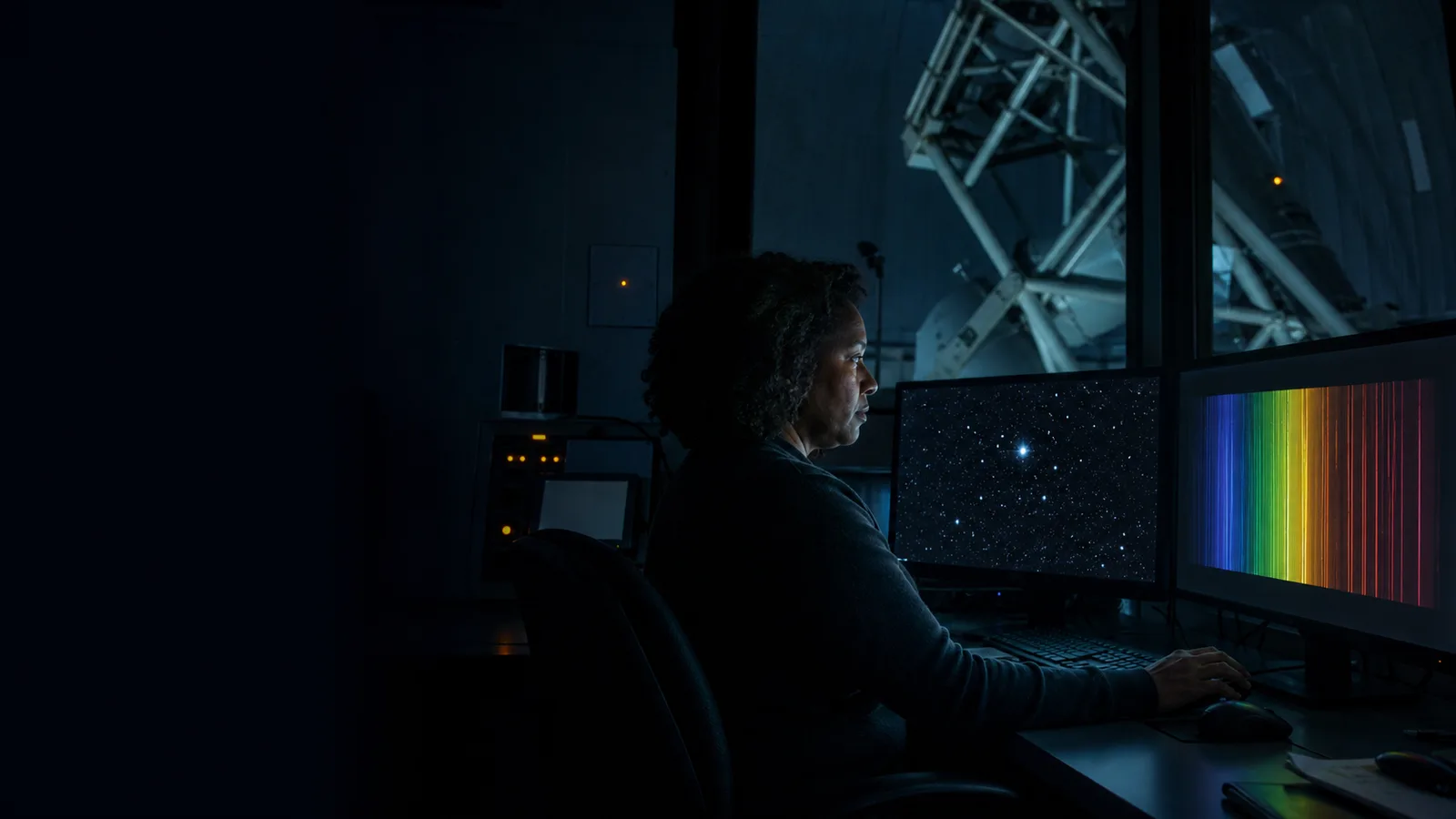
Astronomers collect observations, analyze astronomical data, build mathematical and computational models, develop instruments and software, write research papers, present results, and seek funding for new work.
Use these duties as the first reality check when planning how to become an astronomer.
- Develop theories and models for celestial and physical systems
- Analyze astronomical observations with mathematics and software
- Design or improve scientific instruments
- Write papers and present findings at conferences
- Prepare proposals and apply for research funding
The working day
A Day in the Life of an Astronomer
A research day often starts with data rather than a telescope. You may clean observations, test a model, review an unexpected signal, or write code that can separate an instrument effect from a physical result.
You also write. Astronomers prepare papers, funding proposals, conference talks, and explanations for collaborators. Observation runs can add nights at an observatory, while major facilities may require travel away from home.
Education route
How to Become an Astronomer, Step by Step
When you plan how to become an astronomer, use the sequence below to see where a space-focused degree fits and where you need additional preparation. Research and academic astronomer jobs typically require a Ph.D., often followed by a postdoctoral research position.
- 01
Earn a Quantitative Bachelor’s Degree
Astronomy, astrophysics, or physics is the clearest preparation. Graduate programs also expect calculus, linear algebra, statistics, and strong physics coursework.
- 02
Add Computing and Research Experience
Astronomy now depends heavily on software, numerical models, and large datasets. Undergraduate research shows that you understand how an open-ended scientific question differs from a classroom problem.
- 03
Enter a Physics or Astronomy Ph.D.
Research and academic jobs typically require a Ph.D. Graduate study narrows into a subfield and combines advanced coursework with original research.
- 04
Complete the Dissertation Research
You will develop a research question, work with data or theory, publish results, and defend the work. The process trains you to conduct research with increasing independence.
- 05
Plan for a Possible Postdoc
BLS says research candidates may begin with a postdoctoral position that typically lasts 2 to 3 years before they compete for more independent roles.
Where the work happens
Where Astronomers Work
Universities and Research Organizations
Astronomers work in academic departments and scientific research organizations, where research, writing, teaching, and funding can share the week.
Federal Agencies and National Facilities
Federal employers and federally funded facilities support observational, theoretical, and mission-related research.
Observatories and Remote Facilities
Some astronomers work at observatories. Others visit ground-based or international facilities for observing runs and instrument work.
Technical directions
Astronomer Specialties and Focus Areas
Observational Astronomy
Observational astronomers gather and interpret measurements from ground- and space-based instruments.
Theoretical and Computational Astronomy
These astronomers use mathematics, simulations, and algorithms to explain systems that cannot be manipulated in a laboratory.
Planetary, Stellar, and Galactic Astronomy
Researchers may focus on planets and solar systems, stars and their evolution, or galaxies and large-scale structures.
Optical, Radio, and Gravitational-Wave Astronomy
The instrument and wavelength shape the data, observing methods, and technical skills used in the research.
Before you commit
The Hard Parts of Becoming an Astronomer
The Education Route Is Long
A bachelor’s degree is preparation for the route, not the usual endpoint for research and academic astronomer jobs. The Ph.D. may be followed by a temporary postdoctoral stage.
Research Funding Is Part of the Job
Senior astronomers may need to find funding, write proposals, and manage research work as well as conduct the science.
The Work Can Be Solitary and Exacting
Large datasets and difficult models demand long periods of focus. A small error can change a result or send an analysis down the wrong path.
Observation Schedules Are Not Always Daytime Schedules
Astronomers may work at night during observations and travel to specialized facilities.
BLS wage data
How Much Do Astronomers Make?
The national median is $128,820. The full OEWS wage span runs from $78,010 at the 10th percentile to $195,190 at the 90th. A percentile is a place in the wage distribution, not a promise about your experience level.
Where to study
Schools That Lead Here
Common questions
How to Become an Astronomer: Common Questions
What Degree Do You Need to Become an Astronomer?
Can You Become an Astronomer with Only a Bachelor’s Degree?
How Long Is the Astronomer Education Pathway?
Do Astronomers Work at Night?
Is Astronomy Mostly Telescope Work?
Primary sources
Sources for How to Become an Astronomer
- BLS Occupational Outlook Handbook: Astronomers for duties, education, work settings, and credential context.
- BLS Occupational Employment and Wage Statistics, May 2025 for national and state wages and employment counts.
Occupation facts and wage records updated October 9, 2026.